
Thailand’s fire feels different the moment you arrive. Not the sharp, restless blaze of Bangkok’s woks, but a deeper, older heat — the kind that rises from charcoal pits, clay stoves, and night markets that glow long after the city sleeps. This is where Thai street food stops being a quick bite and becomes a kind of language, spoken through smoke, spice, and the quiet confidence of cooks who have been tending flames for generations.
Here, fire isn’t just a tool. It’s memory. It’s an inheritance. It’s the pulse that ties the country together — from the northeastern grills of Isaan to the coastal markets where heat meets salt and wind. And somewhere between those flames, you begin to understand that Thailand’s fire doesn’t shout. It shapes.
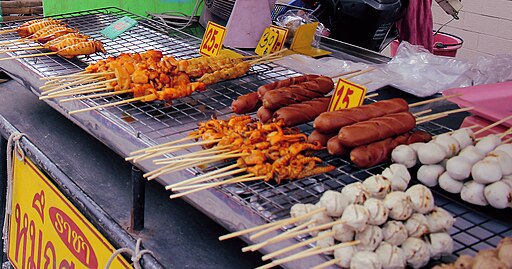
IC: Per Meistrup, CC BY-SA 4.0, via Wikimedia Commons
You start to notice it first in the mornings — the quiet glow of charcoal being coaxed awake, the soft scrape of metal against clay, the way vendors lean into the heat as if greeting an old friend. Thai street food isn’t built on speed; it’s built on patience. Flames rise and fall with intention, guided by hands that know exactly how far to push the fire before it pushes back.
Walk through any market — Chiang Mai’s dawn stalls, Isaan’s roadside grills, the coastal stretches where salt hangs in the air — and the pattern repeats. Heat, then restraint. Spice, then softness. Fire, then flavour. Thailand’s food culture is a study in contrasts, and the flame is the thread that ties them all together.
What surprised me most wasn’t the intensity of the heat, but its gentleness. The way a grill master turns skewers with the same care someone else might reserve for turning pages in a book. The way a wok breathes — rising, falling, settling — as if it has its own pulse. The way every dish feels like a conversation between flame and memory.
And somewhere in that rhythm, you realise: Thailand’s fire isn’t here to overwhelm you. It’s here to teach you how to taste.
Scene Transition — Stepping Into the Fire
You feel it most clearly when you finally stop walking and let yourself be pulled toward a single stall. Mine was a small corner in Chiang Mai’s morning market — nothing dramatic, nothing staged, just a woman tending a charcoal grill with the kind of calm that makes the whole world slow down around her. No signboard. No menu. Just skewers lined up like quiet promises.
The heat wasn’t aggressive. It wrapped around you gently, the way warmth settles into your bones after a long day. She turned each skewer with a rhythm that felt almost meditative — a flick of the wrist, a pause, a lean into the flame. This was Thai street food at its most honest: no rush, no performance, just fire doing what fire has always done here.
When she handed me the first skewer — pork glazed with something sweet, smoky, and impossibly simple — the flavour didn’t explode. It unfolded. Slowly. Patiently. As if the dish trusted you to stay long enough to understand it.
And that’s when it clicked for me:
Thailand’s fire isn’t about intensity.
It’s about intention.
How Thai Street Food Changes Across Regions
Isaan Heat, Chiang Mai Charcoal
If Bangkok is where the fire hits you, Isaan is where it tests you. The northeastern plains carry a heat that isn’t just temperature — it’s temperament. Grills crackle louder here. Spices speak in a higher register. Every skewer, every papaya salad, every charred piece of meat feels like it was made to wake you up from the inside out. Isaan heat doesn’t negotiate. It arrives with confidence, with clarity, with the kind of boldness that makes you understand why so much of Thailand’s flavour DNA begins here. Isaan heat is the boldest expression of Thai street food — sharp, confident, unforgettable.
Isaan’s grilling traditions are some of the boldest in the country, shaped by generations of open‑fire cooking. The Tourism Authority of Thailand documents this beautifully.
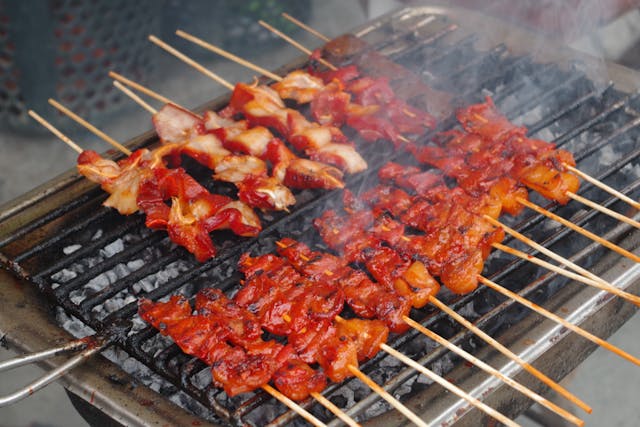
But travel north, and the fire shifts. Chiang Mai’s heat is quieter, almost meditative. Charcoal is the language here — slow, steady, patient. Vendors tend their clay stoves the way gardeners tend soil, coaxing warmth instead of forcing it. The flames don’t leap; they hum. They glow. They hold. And the food that emerges from this kind of fire tastes different: rounder, deeper, touched by smoke rather than consumed by it. What I love about Thai street food here is how the charcoal shapes the flavour without rushing it.
Serious Eats breaks down how Thai charcoal techniques create that slow, steady heat
Between Isaan’s sharp blaze and Chiang Mai’s gentle ember, you begin to see the full spectrum of Thai street food — not as a single style, but as a country‑wide conversation about heat. One region pushes the flame forward; the other pulls it back. One demands your attention; the other earns it slowly. And somewhere between the two, Thailand reveals its truth: fire here isn’t just a cooking method. It’s a map.
Where Heat Becomes Memory
Somewhere between Isaan’s sharp blaze and Chiang Mai’s quiet ember, you begin to understand that Thailand’s relationship with fire isn’t just regional — it’s personal. Every vendor carries their own version of heat, shaped by family, by place, by the kind of mornings they grew up in. And the more you walk, the more you realise that the flame isn’t just cooking food. It’s carrying stories.
I felt this most clearly at a small roadside stall outside Khon Kaen. No crowd, no noise, just a man tending a grill that looked older than the table beside it. He didn’t rush. He didn’t call out. He simply worked — turning chicken wings with a patience that made time feel irrelevant. The smoke curled upward in thin, steady ribbons, as if the fire itself had learned to breathe slowly.
When he handed me a piece — blistered skin, soft heat, a glaze that tasted like someone had distilled sunlight — it wasn’t the spice that stayed with me. It was the warmth. The kind that settles behind your ribs and lingers long after the flavour fades. The kind that feels like memory.
And that’s when Thailand’s fire reveals its final truth: it isn’t meant to overwhelm you. It’s meant to stay with you.
Where the Journey Comes Full Circle
Somewhere between the heat of Isaan and the charcoal calm of Chiang Mai, the entire journey begins to make sense. Manila had been smoke — the kind that lingers on your clothes and follows you long after you leave. Ho Chi Minh City softened that smoke into steam, warm and steady, rising from bowls that felt like morning light. Bangkok sharpened everything into fire, fast and bright, a city that cooks at the speed of its own heartbeat.
But Thailand — the Thailand beyond Bangkok — is where that fire deepens.
Here, the heat doesn’t rush you. It doesn’t demand anything. It simply stays, settling into the food, the air, the rhythm of the markets, the way people tend their grills as if tending memory itself. And as you move through these flames — from the boldness of Isaan to the quiet glow of Chiang Mai — you realise that every stop on this arc has been preparing you for this one.
Smoke taught you to notice.
Steam taught you to listen.
Fire taught you to feel.
And Thailand teaches you to stay.
Because this is where the journey stops being a sequence of cities and becomes a map of elements — each one shaping the next, each one carrying you forward, each one leaving a trace of heat behind. This is the warmth you carry long after tasting Thai street food in its truest form.
For readers curious about the wider history of Thai street food, BBC Travel has an excellent deep‑dive.”
Where the Heat Finally Settles
By the time you leave Thailand, the fire feels less like something you tasted and more like something you carried with you. It settles quietly — the way Manila’s smoke once clung to your clothes, the way Ho Chi Minh City’s steam softened the mornings, the way Bangkok’s blaze sharpened your senses. But here, the heat becomes something steadier. Something that stays without demanding attention.
It lingers in the memory of charcoal mornings.
In the rhythm of skewers turning.
In the warmth behind every dish that was never meant to impress you, only to feed you.
And that’s the quiet truth of Thai street food:
The fire isn’t the spectacle.
The fire is the soul.
You walk away knowing that this journey through Southeast Asia wasn’t just about places. It was about temperatures — the way each city taught you to feel differently, to taste differently, to move differently. Smoke taught you to notice. Steam taught you to listen. Fire taught you to feel. And Thailand, with its patient embers and confident heat, teaches you how to hold warmth without rushing it.
It’s the kind of heat you carry into the next chapter — even if the next chapter takes you somewhere colder.
Closing Transition — From Heat to the Next Horizon
And so you leave Thailand with a warmth that doesn’t fade, even as the journey begins to turn toward colder places. The fire here stays with you — not on your tongue, but somewhere quieter, somewhere steadier. It becomes the kind of heat you carry into new seasons, new cities, new climates. A reminder that every destination leaves its own temperature behind. And as the road shifts from the glow of charcoal to the crispness of winter air, you realise that travel isn’t just about moving through places. It’s about moving through temperatures — learning how each one shapes you before you step into the next.
.