
Ancient readers had their own version of how we hold stories — scrolls tucked into satchels, wax tablets carried on journeys.
This piece explores how humans have carried stories across time — from scrolls to books to screens — and how each format reflects a different way of holding meaning.
Before books looked like books, readers unrolled their stories.
Papyrus rustled. Ink smudged. Shelves held long, ribbon‑tied scrolls with tiny labels dangling from their ends.
(If you’re curious, this lovely detail comes from a recent piece on The Conversation about what books were like in ancient Greece and Rome.)
How We Hold Stories Across Time
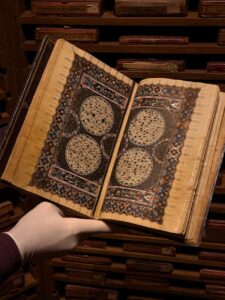
In ancient Rome, people browsed bookshops the way we browse airport stores today — picking up rolls, arguing with dealers about copying errors, and discovering neglected Greek texts sold for cheap. Reading wasn’t passive; it was a ritual of touch, sound, and patience. A scroll wasn’t just information. It was an experience.
And today, we swipe.
We highlight.
We carry entire libraries in our bags.
The debate hasn’t changed — only the format has.
Scroll or codex. Hardcover or Kindle.
Humans have always argued about how stories should be held.
Books or Kindle, scroll or screen — it’s all just a different expression of how we hold stories.”
Maybe that’s why your response to the Manifest review felt so familiar — because every generation has its own way of holding meaning. Some prefer the weight of a book. Some prefer the lightness of a screen. And some, like ancient readers, simply want a story that travels well.
Because in the end, the format changes.
The ritual doesn’t.
🔵The Sensory Side of How We Hold Stories
Some people say a book has a soul.
Not because of the story, but because of the texture around it —
the weight in your hand, the faint crackle of a new spine,
The way a page remembers where your thumb rested.
A Kindle doesn’t do that.
But it does something else.
It disappears.
It lets the words stand alone, without the theatre of paper.
No dog‑eared corners. No underlines from a previous reader.
Just you and the sentence, suspended in a quiet pool of light.
Books demand presence.
Kindles offer permission.
Both are forms of intimacy — just different temperatures of it.
And maybe that’s why the argument never ends.
Because we’re not choosing formats.
We’re choosing experiences.
🔵 Why How We Hold Stories Keeps Evolving
Ancient readers had their own preferences, too.
Some loved the elegance of a tightly rolled papyrus.
Others preferred wax tablets they could erase and rewrite.
Even then, the question was the same:
What does it feel like to hold a story?
And that’s the thread that connects scrolls, books, Kindles, and everything in between —
the quiet human desire to carry meaning in a form that feels like ours.
🔵 Tying Back to the Manifest Series
Maybe that’s why the Manifest review resonated the way it did.
Not because it was a self‑help book, but because it reminded us of something ancient —
that reading has always been a quiet negotiation between who we are and who we hope to become.
Ancient readers unrolled scrolls to find guidance.
We open hardcovers.
We tap a Kindle screen.
Different gestures, same intention.
Every generation finds its own way to hold meaning.
Some choose paper because it feels like an anchor.
Some choose screens because they travel light.
Some move between both, depending on the season of their life.
And maybe that’s the real story here —
not books versus Kindle,
not scrolls versus codices,
But the simple, enduring truth is that humans have always reached for words
when they needed a place to rest, reset, or reimagine themselves.
Just like Manifest did for so many of you.
Just like those ancient scrolls did for readers who lived thousands of years before us.
Formats change.
Rituals evolve.
But the act of reading — the quiet revolution it sparks inside us — stays the same. Maybe how we hold stories changes, but why we reach for them never does.
Quick Summary: How We Hold Stories
- Ancient readers held stories through scrolls, wax tablets, and tactile rituals
- Reading was a sensory act: touch, sound, patience, presence
- Modern formats shift the gesture — swiping, highlighting, carrying digital libraries
- Books offer weight, texture, and physical intimacy
- Screens offer lightness, clarity, and disappearance
- Across time, the question stays the same: what does it feel like to hold a story?
- Formats change, but the ritual of reading — and the meaning we seek in it — remains constant