Bangkok Street Food: 1 Bowl of Boat Noodles by the Canal

Bangkok street food doesn’t ease you in. It doesn’t whisper like Saigon or glow like Manila — it hits you the moment you step onto the street.

If Saigon is steam, Bangkok is heat. Heat from the grills. Heat from the sun. Heat from the wok that never rests.

And somewhere between the chaos and the choreography, I found myself standing at the edge of a canal, drawn toward a stall that had been serving boat noodles long before Bangkok became a postcard. What I love about Bangkok street food is how it blends chaos and precision — every stall feels like a small universe with its own rhythm

The First Hit: Smoke, Spice, Speed

The street was a blur — tuk‑tuks rattling past, vendors calling out orders, the metallic clang of ladles hitting woks. Everything moved fast, but not carelessly. Bangkok’s street food isn’t messy; it’s precise chaos.

A woman stood behind a narrow counter, her hands moving with the kind of speed that comes from muscle memory and necessity. She didn’t look up. She didn’t need to. She knew exactly what each customer wanted before they even opened their mouths.

The broth simmered in a pot that looked older than the stall itself. Dark, rich, almost secretive. The kind of broth that has stories.

🍜 Boat Noodles: Small Bowls, Big Intention

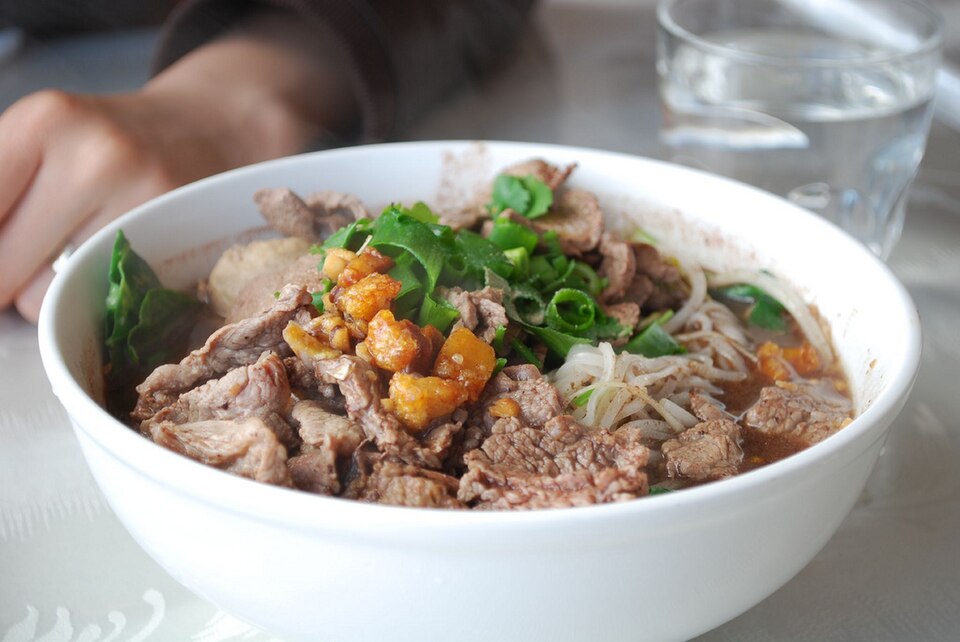
Bangkok street food- Boat noodles
Boat noodles soup. น้ำตก Nam Tok Beef Noodle Soup – Kao Gaeng Thai AUD8.90 IC-
https://www.flickr.com/photos/avlxyz/4045596053/

Bangkok’s boat noodles are tiny — deliberately so. A few bites. A quick hit of flavour. A pause in the middle of the city’s relentless rhythm.

The bowl arrived with steam curling upward like a quiet invitation. Rice noodles. Tender slices of beef. Morning glory. A broth that tasted like it had been simmering for generations.

I took the first sip and felt the shift — the return of fire after Saigon’s softness.

Where Saigon steadies you, Bangkok wakes you. Among all the dishes that define Bangkok street food, boat noodles carry a kind of quiet history in their broth.

Lonely Planet’s Bangkok food guide is a great starting point for understanding the city’s street food culture.

🌶️ Layers of Heat

Bangkok doesn’t do subtle heat. It builds. It stacks. It insists.

Chilli flakes. Vinegar. Fish sauce. Sugar. Crushed peanuts.

Every table has the same quartet of condiments, but every diner creates their own balance. It’s a quiet act of self‑expression — a small rebellion in a city that moves as one.

I added a little chilli. Then a little more. Then a little too much.

Bangkok teaches you your limits. What struck me most was how every stall carried its own signature heat. Some bowls leaned into chilli, others into vinegar, others into the sweetness that Thai cuisine balances so effortlessly. No two vendors tasted the same, yet all of them felt unmistakably Bangkok — bold, bright, and unapologetically alive

🚤 The Canal as a Dining Room

The stall overlooked a narrow canal, the water moving slowly despite the city’s speed. Boats passed occasionally — some carrying tourists, others carrying goods, all carrying stories.

The woman behind the counter didn’t pause. Bowls came and went. Orders flowed like the water beside us.

Something was grounding about eating beside the canal — a reminder that Bangkok wasn’t always skyscrapers and neon. It was once a city of waterways, of floating markets, of meals served from boats.

Boat noodles are a memory of that past, preserved in broth.

For travellers exploring the city’s food scene, the Thailand Tourism page offers a helpful overview of Bangkok’s culinary districts.

🌞 Heat That Stays With You

By the time I finished my second bowl — because one is never enough — the sun had climbed higher, and the city had shifted into its afternoon rhythm.

Bangkok doesn’t slow down. It doesn’t soften. It doesn’t apologise.

But it does feed you — generously, loudly, unapologetically.

And as I stepped back into the street, the heat followed me. Not the kind that overwhelms. The kind that stays. The kind that reminds you that you’re alive.

Glossary of Thai Street Food Terms

Kuay Teow Reua (Boat Noodles) is A concentrated noodle soup once served from boats along Bangkok’s canals. Small bowls, bold flavour, and a broth enriched with spices and tradition.

Nam Tok A broth style deepened with a splash of pig’s blood for colour and richness. Earthy, dark, and essential to authentic boat noodles.

Sen Lek / Sen Yai Thai rice noodle types — sen lek is thin and springy, sen yai is wide and silky. Vendors often ask for your preference with a single gesture.

Morning Glory (Pak Boong) A crunchy, water‑grown vegetable often added to noodle soups. Light, fresh, and a quiet contrast to Bangkok’s heat.

Khlong Bangkok’s canal network — once the city’s main transport system. Many boat noodle stalls still sit along these waterways, echoing the city’s past.

Thai Condiment Quartet: Chilli flakes, vinegar with chillies, fish sauce, and sugar. Every diner adjusts their bowl to taste — a small act of personal expression.

🔗 Closing the Arc

Manila was smoke.

Ho Chi Minh was steam.

Bangkok is fire.

This fire of Bangkok feels even sharper when I think back to the gentle steam of my Vietnam post, where pho at dawn slowed the world for a moment.

Three cities.

Three bowls.

Three ways of understanding a place through what it feeds you.

And eastward, the journey continues.

If you’ve been following this arc, my Manila chapter explores how smoke and street corners shape a city’s flavour.

For readers who enjoy slow, sensory food stories, my Lisbon street food post explores a different rhythm of flavour.

Ho Chi Minh City Street Food: 1 Bowl of Pho at Dawn


🇻🇳 Ho Chi Minh City Street Food: A Bowl of Pho at Dawn

Ho Chi Minh City street food has a way of finding you before you even know you’re hungry. Some cities wake up gently, but Saigon rises with the hum of motorbikes, the clatter of shutters, and the unmistakable scent of broth drifting through narrow alleys like a quiet summons. I wasn’t looking for breakfast. But in Ho Chi Minh City, breakfast has a way of choosing you.

🌅 A Street Corner, A Cart, A Pull

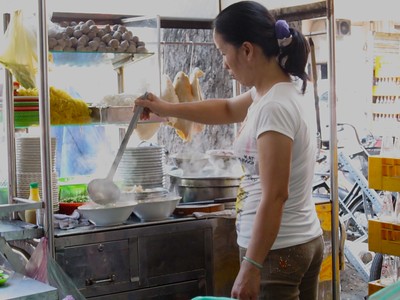
I turned a corner expecting nothing more than the usual morning rush — vendors setting up, commuters weaving through traffic, the city stretching itself awake. Instead, I found a small metal cart, half‑hidden behind a tangle of motorbikes. A pot of broth simmered steadily, releasing soft clouds of steam that curled into the air like a promise.

Street Food in Ho Chi Minh City
IC: DavidnKeng’s photo, licensed as CC BY-NC-ND 2.0

No signboard. No menu. Just a woman with decades of muscle memory in her hands, moving with the calm precision of someone who has fed half the neighbourhood.

This is the heart of Ho Chi Minh City street food — unassuming, unadvertised, unforgettable.

🔥 The Ritual of Pho

She worked quickly, but nothing felt rushed.

A ladle dipped into the broth. Noodles loosened with a practiced flick. Herbs torn by hand. Beef slices arranged like a quiet offering.

The choreography was effortless — a performance repeated thousands of times, yet still tender in its intention. The pot was her universe. The street was her dining room. And for a moment, I was simply a guest in her morning rhythm.

This tiny cart captured everything I love about Ho Chi Minh City street food — the quiet confidence, the unpolished charm, the flavours that speak without shouting.

🍜 First Bite: Steam, Softness, Stillness

Pho doesn’t shout. It doesn’t overwhelm. It unfolds.

The broth was soft but deep, carrying warmth without weight. The herbs brightened the edges. The lime lifted everything. The beef melted into the morning. It felt less like eating and more like being steadied — a gentle recalibration after Manila’s smoky chaos.

If Manila is grill, Saigon is steam.

🌿 What Pho Means Here

Pho, Ho Chi Minh City street food
IC: Vinnie CartabianoFlickr

Pho is not just breakfast. It is a balance.

A bowl that holds:

  • colonial history softened into comfort
  • migration turned into a flavour
  • resilience simmered into broth
  • the city’s contradictions — chaos outside, calm inside

In Ho Chi Minh City, food is not merely consumed. It is lived. There’s a reason Ho Chi Minh City street food is often described as the soul of Vietnam — it turns ordinary mornings into small rituals of comfort

Read more: Ho Chi Minh City Street Food: 1 Bowl of Pho at Dawn

——-> If you’d like to know more about Pho

🏍️ The Street as a Living Organism

As I ate, the city continued its choreography around me. Motorbikes zigzagged like schools of fish. Vendors called out to familiar customers. A child balanced on the back of a scooter, half‑asleep, head resting on a parent’s shoulder. Life moved fast, but the bowl in front of me insisted on slowness.

This contrast — motion outside, stillness inside — is the essence of Saigon’s food culture.

For travellers curious about the broader food culture of the city, the official Vietnam tourism page offers a helpful overview of Ho Chi Minh City’s culinary traditions

🌤️ A Moment of Stillness in Motion

I finished the last sip of broth and felt something shift. Not dramatically. Not loudly. Just a soft settling, the kind that comes from being exactly where you’re meant to be, even if only for a moment.

I left the cart lighter, carrying the warmth of pho into the day — a softness that Manila didn’t offer, but one that Saigon gives freely.

FAQ: Ho Chi Minh City Street Food

Q: What is the best time to try street food in Ho Chi Minh City?

Early mornings and late evenings are ideal, when vendors prepare fresh broth, and the streets come alive.

Q: Is pho the most popular breakfast dish in Saigon?

Yes — pho is one of the most common breakfast choices, though dishes like cơm tấm and bánh mì are equally beloved.

Q: Is street food safe to eat in Ho Chi Minh City?

Generally, yes, especially at busy stalls where food turnover is high, and ingredients are cooked fresh.

🔗 Closing the Arc

As I walked away, I realised why Ho Chi Minh City street food is celebrated worldwide — it nourishes more than hunger; it steadies the spirit. Walking away, I understood why Ho Chi Minh City street food stays with travellers long after they leave — it nourishes memory as much as appetite.

This chapter continues the journey that began with Manila — Glitter, Grief & Grill, where smoke and emotion shaped the streets. Here in Saigon, the warmth is quieter, the flavours gentler, the mornings slower.

And eastward, the arc continues — towards Thailand, where the fire waits.

If you enjoy slow, sensory travel stories, my earlier post on Lisbon’s street food rhythms explores a similar blend of culture and flavour.


Manila — Glitter, Grief, and Grill

She wore glitter like armor.
Not to dazzle, but to deflect.
In Manila, street food isn’t just flavor—it’s a shield, a song, a survival script.

From the smoky defiance of Oaxaca to the crowned comfort of Caracas, the trilogy finds its final beat here: in the neon-lit alleys of Quiapo, where skewers sizzle, banana cues caramelize, and stories simmer. Manila’s streets are alive with contradictions—grief wrapped in glitter, hardship softened by sweetness, and resilience fried into every bite.

The Renaming Ritual

Isaw. Betamax. Adidas.
Street food in Manila often carries playful names—borrowed from pop culture, shapes, or everyday symbols.
This isn’t culinary irony. It’s coded resilience.
Vendors transform humble ingredients into stories, renaming them to spark curiosity and connection.

But beyond the skewers, there’s a gentler rhythm:

  • Banana Cue — plantains glazed in caramelized sugar, skewered not for irony but for indulgence.
  • Turon — crisp spring rolls filled with banana and jackfruit, golden pockets of joy.
  • Taho — silken tofu with syrup and sago pearls, a morning ritual in a cup.

Each name is a record.
Each flavor, a return.
Not of currency, but of courage.

Street food here is an economy of trust: a few pesos exchanged for a taste of belonging. The renaming ritual turns survival into shared humor, and scarcity into creativity.

Each flavor carries its own rhythm—sometimes survival, sometimes joy. In investing, too, withdrawals and dividends carry echoes of risk and return. Sharath’s Shadow: The SWP Mirage explores this mirage in portfolios.”

Glitter and Grief

Manila’s street food glows under fluorescent halos.
But behind the sparkle lies grief—of displacement, of debt, of dreams deferred.

You taste it in the vinegar dip, sharp and cleansing.
You hear it in the vendor’s rhythm, the clatter of skewers and frying pans.
You feel it in the pause between bites, when silence lingers longer than smoke.

The glitter is not frivolous—it’s defiance. A way to shine even when shadows loom.


Sweet Shields

Vegetarian-friendly staples soften the grit of Manila’s alleys, offering sweetness as a counterpoint to the savory smoke:

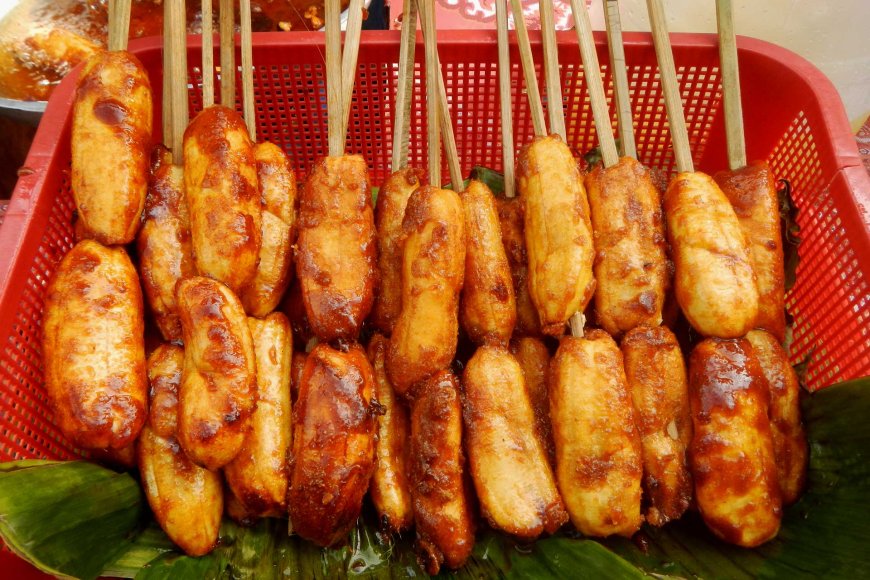
Banana cue skewers caramelized in sugar, a sweet Filipino street food staple in Manila’s night markets.
Banana cue—Manila’s sweet shield, caramel armor against hunger.
IC: www.nipino,com

  • Banana Cue: Plantains glazed in caramelized sugar, skewered not for irony but indulgence. Each bite is a shield—golden armor against hunger, a reminder that sweetness can be as sustaining as spice. Banana cue vendors often line the edges of Divisoria, their skewers glowing like lanterns in sugar glaze.
  • Manila street food turon, a vegetarian friendly Filipino dessert of fried banana spring rolls.
    Turon _ Traditional deep fried dessert from Philippines IC: www.tasteatlas.com
  • Turon: Crisp spring rolls filled with banana and jackfruit. They crackle with laughter, folded into pastry, carrying joy in portable pockets. Turon is not just dessert—it’s a handheld celebration, a festival wrapped in filo. Turon is festival food—sold at fairs, school gates, and bus stops, carrying joy in portable form.
  • Taho, silken tofu with syrup and sago pearls, a comforting Filipino street food served at dawn in Manila.`
    TAHO _ Philippines Street food-silken tofu with sago pearls and brown sugar syrup -IC: you tube.com
  • Taho: Silken tofu layered with syrup and sago pearls, sold in cups at dawn. Vendors call out “Taho!” in the morning streets, their voices echoing like hymns. It is comfort in liquid form—warm, gentle, and restorative. Taho is a morning ritual; vendors balance aluminum buckets, calling out “Taho!” as children and workers gather for comfort before the day begins.

These dishes remind us that resilience isn’t only savory—it can be sweet, soft, and sustaining. In a city where grief often lingers, sweetness becomes a shield, a way to soften hardship and preserve hope.

Sweet shields are more than food—they are rituals of care. They show that survival is not only about enduring bitterness but also about finding sweetness in the everyday.


Practical Tips

  • Where to eat: Quiapo night market, Cubao Expo, and Divisoria’s bustling lanes
  • What to try: Banana cue, turon, taho, kwek-kwek (vegetarian-friendly if egg is acceptable)
  • When to go: Dusk—when the city softens, grills awaken, and neon lights turn alleys into stages
  • How to pace it: Start with taho, pause for turon, end with banana cue for balance.

Trilogy Echo

  • Caracas: “Cream. Crown. Caracas.” — comfort as sovereignty
  • Oaxaca: “Oaxaca and the Smoke Ritual” — defiance as flavor
  • Manila: “Glitter, Grief, and Grill” — longing as ledger

Together, they form a ritual route: three cities, three flavors, three ways of surviving. Each post is a beat. Together, they are a trilogy of taste and tenacity.

Follow the Ritual Route.

From crowned comfort in Caracas to smoky defiance in Oaxaca to glittering grief in Manila—each dish is a story, each blogpost a rhythm. Manila closes the trilogy arc, but the taste lingers—waiting for the next city to rise.

And revisit the earlier beats of the trilogy:


.

Oaxaca and the Smoke Ritual

Oaxaca street food rituals — smoky tlayuda and mole negro served with lime"

 Street Food Diaries — Season 2: The Ritual Route

Oaxaca and the Smoke Ritual

From crowned comfort to smoky defiance, the Ritual Route moves from Caracas to Oaxaca — a city where fire, spice, and ancestral rhythm shape every bite. If Caracas whispered memory through avocado and maize, Oaxaca speaks in smoke and spice, in tlayudas that crackle and moles that simmer for hours. Here, food is not just sustenance — it is resistance, ritual, and the quiet architecture of identity.

In Street Food Diaries — Season 2, Oaxaca becomes the second beat in a trilogy that began with the Reina Pepiada’s soft crown. This time, the ritual is bolder. Earthier. A celebration of roots that burn slow and deep.


Rituals of the Zapotec Kitchen

In Oaxaca, food is not prepared — it is performed. Rooted in Zapotec and Mixtec traditions, the city’s kitchens are spaces of ceremony, where smoke curls like prayer and spice is measured by memory, not spoons. Mole negro, the region’s most iconic sauce, simmers for days — a blend of chilies, chocolate, and ancestral rhythm. It is not made in haste. It is summoned.

Street vendors carry this legacy in every tlayuda they grill, every memela they press. The act of cooking becomes a ritual of resistance — preserving identity through flavor, fire, and time. In Oaxaca, to eat is to remember, and to cook is to honor. For a visual journey through Oaxaca’s vibrant street food scene, National Geographic’s photo story captures the textures, rituals, and rhythms of the city’s antojitos.

Flavor Grid — Smoke, Spice, and Street Rhythm

  • Tlayuda: A giant, crispy tortilla layered with beans, asiento (pork fat), cabbage, and grilled meats
  • Mole Negro: Deep, dark, and complex — a sauce that tastes like memory and midnight
  • Chapulines: Toasted grasshoppers, crunchy and citrusy, eaten with lime and salt
  • Tejate: A pre-Hispanic drink made from maize and cacao, served cold in clay cups
  • Memelas: Thick tortillas topped with beans, cheese, and salsa — comfort in every bite

To understand how mole negro became Oaxaca’s most iconic sauce, this deep dive into the origins of mole negro explores its ritual roots and ancestral complexity.

Poetic interlude:
She danced with smoke. Her spice was a story. Her silence, a simmer.

Market Rhythms — Oaxaca’s Daily Pulse

Beyond the smoky kitchens and late‑night tlayuda grills, Oaxaca’s markets are living archives of flavor. At Mercado 20 de Noviembre, stalls overflow with chapulines, chilies, and cacao — each ingredient carrying centuries of ritual. Vendors call out in Zapotec and Spanish, their voices weaving commerce with culture.

Here, food is not just sold; it is narrated. A grandmother explains the difference between mole coloradito and mole negro, while a young vendor offers tejate, a frothy maize‑cacao drink once reserved for ceremonies. The market becomes a classroom, a stage, and a memory bank all at once.

For travelers, wandering these aisles is as essential as tasting the dishes. It’s where the trilogy’s emotional arc finds its heartbeat — Caracas whispered memory, Oaxaca chants resistance, and Manila will soon echo longing.

Further reading: National Geographic’s photo story on Oaxaca’s street food culture

Trilogy Cue — From Caracas to Manila

If Caracas was memory and Oaxaca is defiance, Manila waits with glitter and grief. The trilogy arc moves from softness to smoke to longing — each city offering a distinct emotional beat. In Tokyo, smoky teriyaki skewers pulsed through neon alleys. In Lisbon, bifanas and pastel de nata carried migration and heritage. Oaxaca adds heat, depth, and ancestral pride to the map.

Closing Note — The Ritual of Resistance

The Ritual Route is not just about food. It’s about how dishes become ceremonies — how flavor becomes memory, and memory becomes survival. In Oaxaca, every bite is a quiet protest, a celebration of roots that refuse to be erased.

From crowned comfort to smoky defiance…”
→ read more: /street-food-diaries-caracas-reina-pepiada