
Where Borders Blur in Armenia’s Living Geography
Some places don’t ask you to choose between stillness and motion — they hold both, quietly. Armenia is one of those threshold geographies, where borders soften, and the world feels less divided.
You sense it in the way mountains rise like unfinished thoughts, in the way monasteries sit between centuries, in the way light moves across stone as if time itself is breathing. Here, crossing a border isn’t an act of travel; it’s an act of attention.
Armenia doesn’t pull you forward or hold you back — it simply opens, inviting you to notice what shifts inside you when the landscape stops trying to impress and starts to reveal.
Threshold places are rarely loud; they work in subtler ways. Armenia’s geography teaches this first.
You move through it not in straight lines but in gentle crossings — from forest to meadow, from basalt cliffs to open sky, from the hush of a monastery corridor into the wide breath of a valley.
Each shift feels like stepping through an invisible doorway. Nothing announces the transition, yet you feel it: a soft recalibration of pace, attention, and inner weather.
In Armenia, landscapes don’t separate one moment from the next — they stitch them together, reminding you that movement is often just the mind learning to see again.
But it is in Armenia’s monastic spaces that borders feel the most porous.
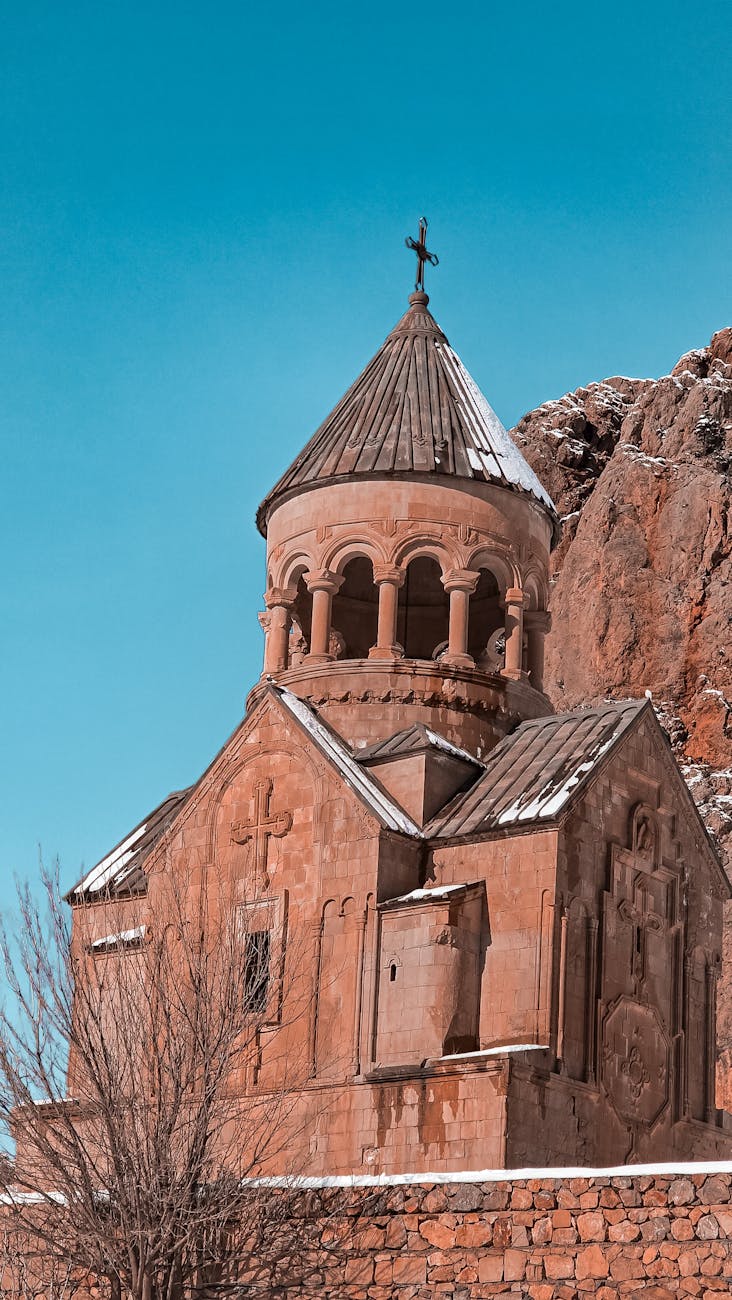
Step into any ancient chapel — Noravank, Haghpat, Tatev —, and you sense how the boundary between the earthly and the sacred thins to a breath. Stone walls hold centuries of prayer, yet nothing feels closed; everything opens.
Light slips through narrow windows like a quiet invitation, blurring the line between shadow and illumination, between the self you carried in and the one that stands still now.
These monasteries are thresholds in the truest sense — places where borders are not drawn but dissolved, where the spiritual and the physical meet without conflict, and where movement becomes a kind of inward crossing.
This spiritual threshold is also what shapes Armenia’s creative energy — something you explored in 6 Ways Writers Retreat — and the Armenian Landscapes That Hold Them. Writers, artists, and wanderers often find themselves returning to Armenia not for inspiration in the conventional sense, but for the way the land rearranges their inner borders.
The country doesn’t offer escape; it offers clarity. It doesn’t offer silence; it offers resonance. Armenia becomes a retreat not because it is remote, but because it is permeable — a place where the inner and outer landscapes speak to each other without interruption.
Cultural Borders That Soften Into Continuities
Armenia’s culture carries its own kind of borderlessness. Centuries of crossings — traders, poets, pilgrims, empires — have left traces that don’t compete but coexist. You feel it in the food that blends Middle Eastern warmth with Mediterranean brightness, in the music that holds both lament and celebration, in the language that sounds ancient yet alive. Here, cultural borders don’t harden into identities; they blur into continuities.
Armenia stands at the meeting point of influences, yet it belongs fully to none of them — and that is its quiet strength. It teaches you that culture is not a line drawn around a people, but a living threshold shaped by everything that has passed through and everything that remains.
When Inner Borders Shift: The Traveler’s Threshold
In the end, Armenia’s power lies not in any single threshold but in the way they echo one another. The land blurs the borders between terrains; the monasteries blur the borders between the seen and the felt; the culture blurs the borders between influences carried across centuries. And somewhere within these crossings, you begin to sense your own borders shifting — the ones you didn’t know you held.
Armenia doesn’t ask you to choose a direction; it simply invites you to stand at the meeting point of many worlds and notice how movement, in all its forms, reshapes you. In this place where borders soften, you realise that thresholds are not edges but invitations — quiet openings into a deeper way of being present.
Where Borders Blur: Armenia and the Poetry of Threshold Places,
inspired by the mood, cadence, and philosophical undercurrent of the Movement essay
You may like to explore Almaty, Kazakhstan