7 Reasons Baku’s Old City and Modern Skyline Feel Like Two Worlds in One
Baku’s Old City: Stone, Shadows, and Silk Road Memory
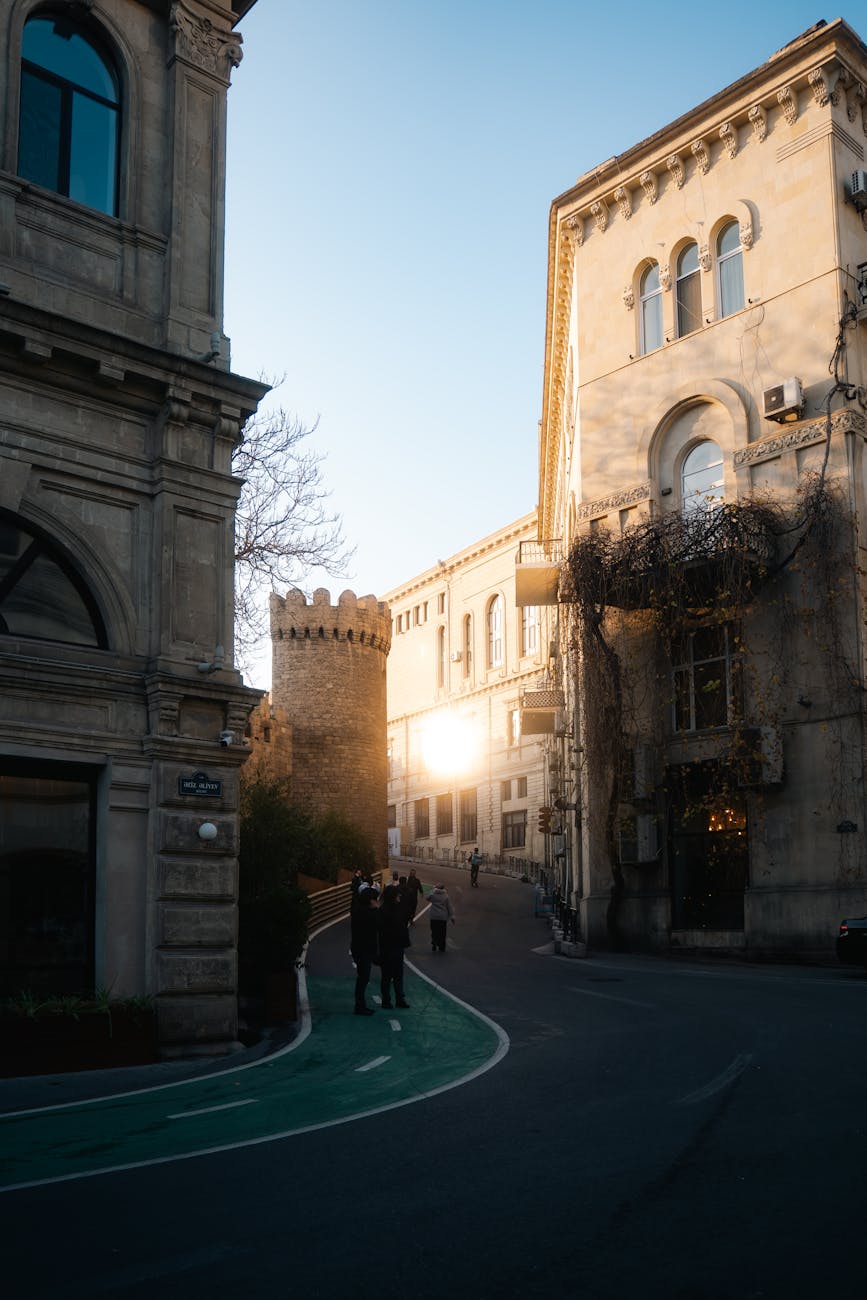
Baku’s Old City is the kind of place where time doesn’t pass — it gathers. Within the fortified walls, the world narrows into warm sandstone lanes, carved wooden balconies, and archways that hold centuries of footsteps. The geometry here is intimate: curved doorways, patterned stone, and the soft rhythm of alleys that turn gently rather than sharply. You feel the Silk Road in the air — not as a historical fact, but as a texture.
Walk slowly and the city reveals itself in layers. A caravanserai courtyard opens unexpectedly, its stone cool even in the afternoon sun. A teahouse hums quietly behind a wooden door. The Maiden Tower rises like a memory carved into the skyline, its cylindrical form both ancient and strangely modern. Everything in the Old City feels lived‑in, softened, and shaped by hands rather than machines.
Where Old Baku Meets the Modern Skyline
Step outside the walls and the city shifts almost instantly. Modern Baku rises in glass curves and mirrored silhouettes, catching the Caspian light in ways the Old City never needed to. The Flame Towers shimmer like sculpted fire, reflecting the sky in blue, gold, and silver. Wide boulevards replace narrow alleys. The wind feels different too — sharper, faster, carrying the scent of the sea rather than stone.
This contrast is not a clash. It is a conversation between eras.
Old Baku whispers in sandstone; modern Baku answers in glass. One holds memory, the other holds momentum. Together, they create a skyline that feels both rooted and restless — a city that remembers its origins but refuses to stay still.
The Caspian Mood: Wind, Water, and Horizon
Baku’s geography shapes its personality. The Caspian Sea is not just a backdrop; it is a mood. The wind arrives in long, sweeping currents that move through the city like a living presence. On some days it carries the scent of salt and open water; on others it brings a coolness that settles into the stone.
Spend a little time on the boulevard and you’ll notice how the city leans into the horizon. The sea stretches out in a muted blue, the skyline rises behind you, and the Old City sits quietly to the side — a triangle of time, water, and architecture. Evening brings a different geometry: lights flicker on across the waterfront, the Flame Towers glow like embers, and the Old City settles into shadow. This is when Baku feels most balanced — neither ancient nor futuristic, but something in between.
A City Balanced Between Past and Future
What makes Baku unforgettable is not its monuments or its skyline, but the seam where the two meet. You can stand on a single street and feel centuries behind you and decades ahead of you. The city doesn’t force you to choose between them. It lets you hold both.
In the Old City, you walk through history. In the modern skyline, you walk toward possibility. In the Caspian wind, you feel the thread that ties them together.
Baku is not a city of extremes — it is a city of transitions. And it is in these transitions that its beauty lives.
For readers who enjoy cross‑border continuity and quiet transitions, your earlier post fits perfectly: Armenia to Azerbaijan Travel: 5 Quiet Ways the Landscape Softens Across the Border
To explore the architectural history of the Old City, UNESCO offers a concise overview: Baku’s Walled City (UNESCO World Heritage)