5 Reasons Khiva in Evening Light Feels Like the Silk Road’s Quietest Story
Khiva is a city that reveals itself slowly. In the soft fall of evening, the desert cools, the walls warm into gold, and the old town settles into a rhythm that feels older than the Silk Road itself. This is a place where time stretches, where footsteps soften, and where the day closes with a kind of quiet that feels almost ceremonial.
Khiva is not a city of spectacle. It is a city of mood — of texture, shadow, and stillness.
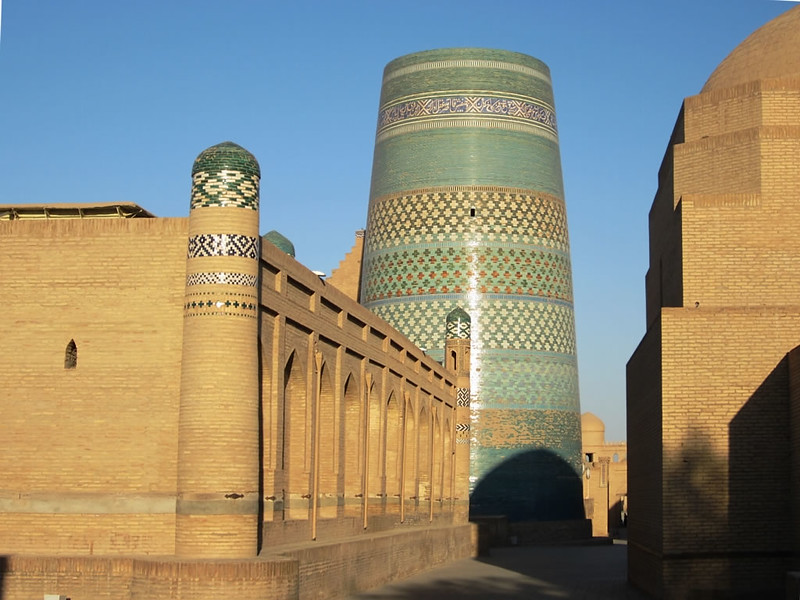
The Kalta Minor Minaret in Khiva, Uzbekistan, was left unfinished when its builder died in 1855. IC: David Stanley | Flickr
The Geometry of Desert Walls in Khiva
Khiva’s architecture is shaped by heat, wind, and silence. The walls curve gently, softened by centuries of sand and sun. Nothing here is sharp. Nothing is hurried.
The city feels carved from the desert itself — a geometry of survival, shade, and stillness. As you walk through the narrow lanes, the walls seem to hold the warmth of the day. They glow softly, as if lit from within.
For a factual overview of Khiva’s old town, UNESCO provides a concise reference.
Evening Light and Mood of Old Town
Evening is when Khiva reveals its true mood.
The minarets catch the last light, turning into tall silhouettes against a sky that shifts from gold to blue. Shadows lengthen across the alleys. The air cools, but the warmth of the day lingers in the walls.
You hear footsteps differently here — slow, unhurried, softened by sand. A distant call to prayer rises and falls like a breath. The city feels both ancient and immediate, as if time has folded in on itself.
A Rhythm That Moves at the Pace of Sand
Inside the old town, the streets feel like corridors. They guide you gently, without urgency. Courtyards open unexpectedly — quiet, shaded, holding the day’s heat like a secret.
Khiva moves at a different pace from Samarkand or Bukhara. It is quieter, more introspective, more attuned to the desert’s slow pulse.
For readers exploring the earlier parts of Silk Road arc, 7 Reasons the Journey from Samarkand to Bukhara Feels Like a Living Silk Road Story
Khiva and the Silk Road
Khiva was one of the final stops before caravans crossed long stretches of desert. It was a place of rest, preparation, and pause.
Travellers arrived with dust on their clothes and stories in their hands. They stayed long enough to gather strength, to trade, to listen, to breathe.
Khiva carries that memory in its walls. You feel it in the stillness. You feel it in the way the city holds the evening light.
For a broader Silk Road context, the Smithsonian archive offers a neutral overview.
A Soft Close to the Month
Khiva is the perfect ending to your May arc — a gentle exhale after the geometry of Samarkand and the silence of Bukhara.
The city closes the month the way evening closes the day: slowly, softly, without urgency.
From here, the narrative shifts. The desert gold of Khiva will give way to the turquoise palette of June. The Silk Road will dissolve into ocean light. And the month will end the way all good journeys do — with a quiet moment of stillness before the next chapter begins.