
The Samarkand to Bukhara Silk Road Journey
There are journeys that feel like movement, and there are journeys that feel like memory. The route from Samarkand to Bukhara is both — a slow geography shaped by blue tiles, desert silence, and the lingering rhythm of the Silk Road.

In the first light of Samarkand, the Registan glows in a way that feels almost intentional. Blue tiles catch the sun, gold settles on geometry, and the city opens like a page turning. This is where the Samarkand to Bukhara journey begins: in stillness, in symmetry, in a quiet that feels older than the road itself.
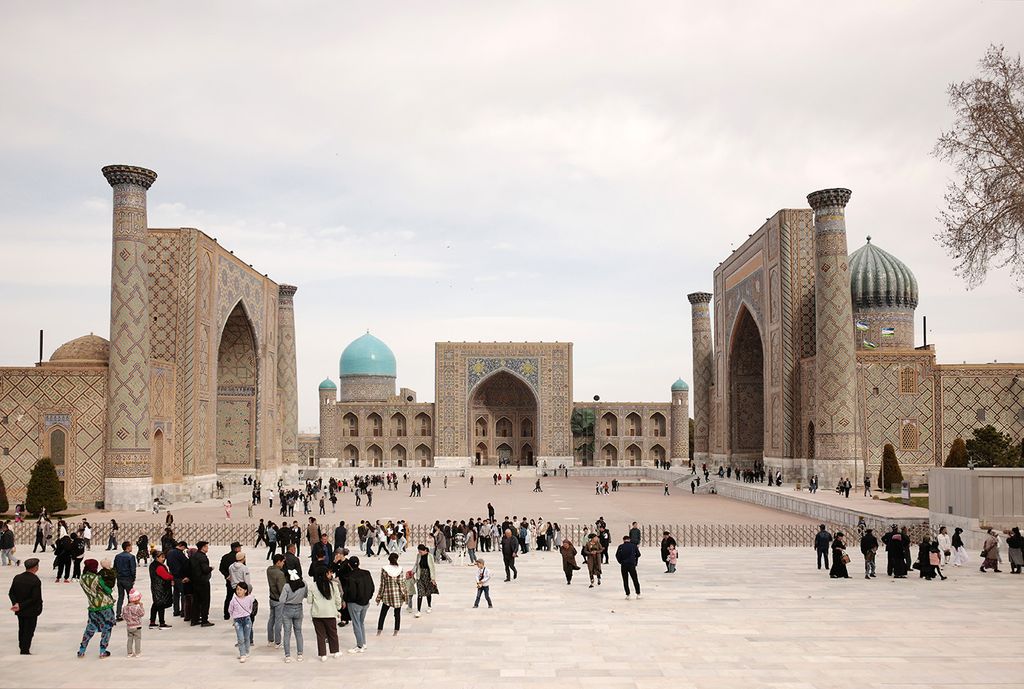
Along the Samarkand to Bukhara route, the landscape shifts from blue geometry to warm desert silence
Geometry as a Language
Geometry Along the Samarkand to Bukhara Route

Standing before the Registan, you realise that geometry is not decoration here.
It is a form of storytelling.
Repetition becomes rhythm.
Symmetry becomes memory.
Patterns become a kind of map — guiding the eye the way old routes once guided caravans.
Every tile feels like a small archive of the Silk Road:
a record of hands, colours, and ideas that travelled farther than any single caravan ever could.
For readers, curious about the architectural history of the Registan, the UNESCO listing offers a factual overview.
Samarkand teaches you that movement is not always loud. Sometimes it is a pattern repeated across centuries.
The journey from Samarkand to Bukhara feels less like travel and more like moving through layers of memory.
The Silk Road as a Living Idea
It is easy to imagine the Silk Road as a line on a map.
But in Samarkand, it feels more like a pulse.
Caravans once arrived here carrying silk, spices, stories, and news from distant places.
The city absorbed all of it — not just the goods, but the rhythms of travel itself.
Movement shaped the architecture.
Trade shaped the rituals.
Thresholds shaped the culture.
For a deeper historical context, the Silk Road overview by the Smithsonian provides a neutral, factual reference.
Samarkand is a crossroads, but not a hurried one.
It is a place where movement slows just enough to become memory.
Leaving the Blue City
The road from Samarkand to Bukhara is a soft transition — a gradual shift from tile geometry to desert horizon.
The colours flatten.
The air warms.
The landscape opens.
It feels like moving from complexity to stillness.
And then, almost without noticing, you enter Bukhara.
Travellers on the Samarkand to Bukhara stretch often describe it as a quiet unfolding of the Silk Road.
Bukhara: Courtyards, Shade, and Desert Silence
If Samarkand is a map, Bukhara is a pause.
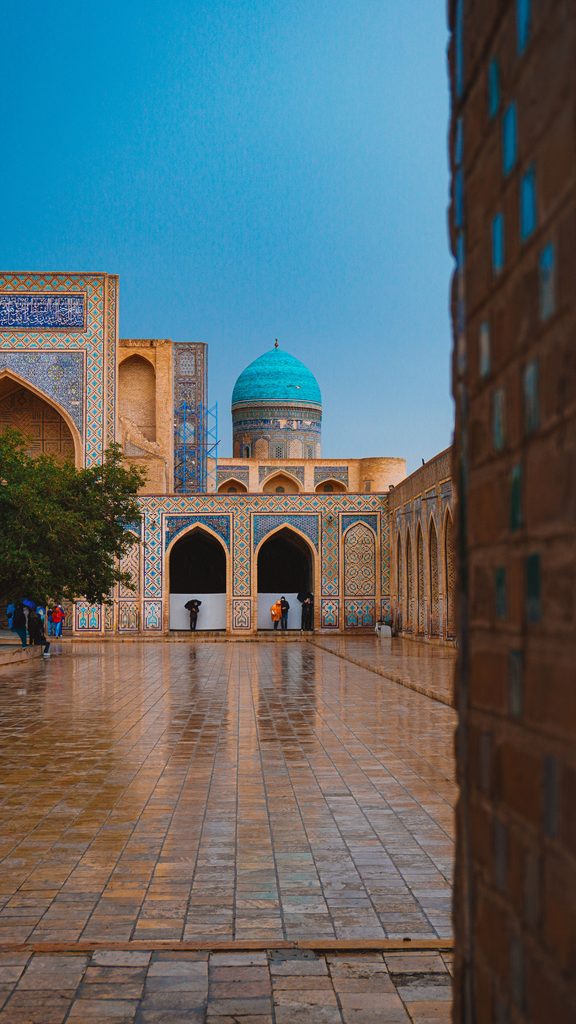
Courtyards appear like small worlds of their own — shaded, cool, and quiet.
Water pools in the centre.
Trees lean inward.
The desert breathes around the walls.
Here, architecture is shaped by climate.
Shade is geometry.
Silence is a resource.
For readers who want a factual reference on Bukhara’s old town, UNESCO provides a concise overview.
Bukhara teaches you that stillness can be a form of travel too.
The Texture of Desert Silence
Silence in Bukhara is not empty.
It has weight, temperature, and distance.
You hear footsteps differently.
You hear your own breath differently.
You hear the city differently — as if every sound has been slowed down by the heat.
This is the Silk Road’s other rhythm:
not movement, but rest.
Caravanserai Culture
The caravanserais of Bukhara are reminders that the Silk Road was never only about trade.
It was about pause.
Travellers arrived with stories, rituals, and memories.
They rested, exchanged, listened, and continued.
Thresholds mattered as much as routes.
Stillness mattered as much as movement.
For readers who want to explore Silk Road food traditions,
In these courtyards, you understand the Silk Road not as a journey, but as a conversation.
A Quiet Handover to Khiva
As you leave Bukhara, the desert deepens.
The light softens.
The road narrows into a long, quiet stretch toward Khiva.
The geometry of Samarkand, the silence of Bukhara, and the horizon ahead form a single, continuous line — a slow geography that carries the month forward.
This is where the Silk Road becomes a mood.
A way of seeing.
A way of moving through the world.
And it prepares you gently for the next chapter.

Kash Pals writes about mindful travel, local flavours, and the quiet details that make places unforgettable. She curates Best Places of Interest as a space for travellers, food lovers, and culture seekers.