Caspian Moodboard: Wind, Water, and the Quiet Geometry of the Sea
The Caspian Sea is not a place that announces itself. It doesn’t shimmer loudly or crash dramatically against the shore. Instead, it moves with a kind of quiet certainty — a surface that shifts like brushed metal, a horizon that dissolves into sky, a wind that carries the scent of salt and stone. It is a landscape that teaches you to pay attention to subtleties, to the slow gestures that define its character.
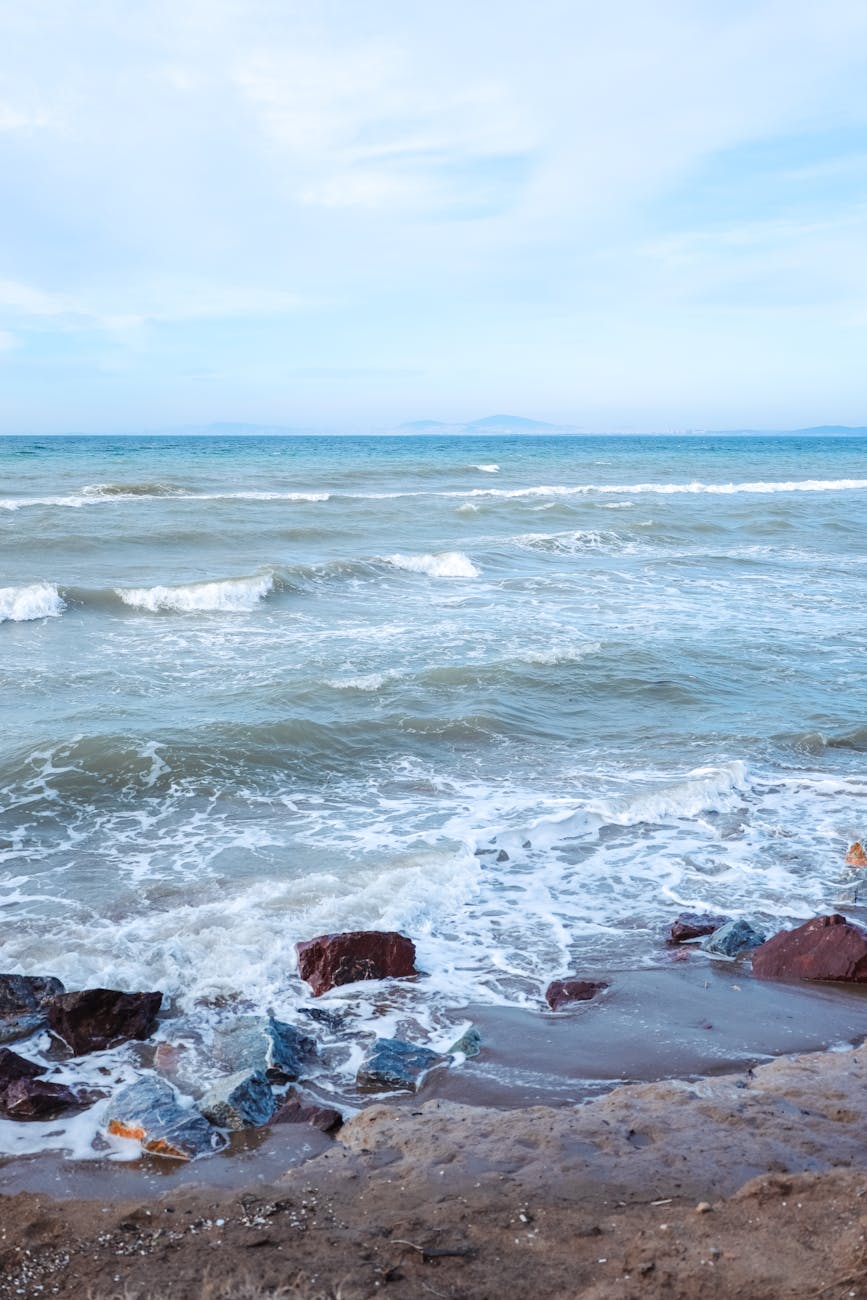
Stand by the water in the early morning and the world feels reduced to essentials: grey light, soft waves, the outline of a distant oil rig softened by haze. The Caspian has its own palette — muted blues, pale greens, the occasional streak of silver when the sun breaks through. It is a moodboard made of restraint, a place where minimalism feels natural rather than intentional.
1. Wind as Architecture
In Baku, the wind is a kind of architect. It shapes the city’s rhythm, pushes against the old walls of Icherisheher, and sweeps through the modern skyline with equal authority. Locals call it khazri, a northern wind that arrives with a sharpness you can feel in your bones. It carries the sea inland, threading through narrow streets and open boulevards, reminding you that the Caspian is never far.
The wind gives the city its texture — a sense of movement even on still days, a quiet insistence that the landscape is alive.
2. Water as Memory
The Caspian holds centuries of stories: Silk Road traders, fishermen, poets, and travelers who stood at its edge and watched the horizon shift. The water has a way of absorbing memory without revealing it. It feels ancient, self-contained, almost private.
There is a calmness in its depth — a sense that the sea has seen everything and forgotten nothing. Its surface may appear still, but beneath it lies a history shaped by trade, migration, and the slow passage of time.
3. Stone as Stillness
Along the coast, stone becomes a kind of punctuation. Weathered steps lead down to the water. Breakwaters stretch into the distance like quiet markers. The architecture near the shoreline — old, new, and everything in between — seems to borrow its patience from the sea.
The Caspian doesn’t rush. It waits. And the landscape around it learns to do the same.
4. Light as Language
The light here is different. It doesn’t arrive in dramatic bursts. It slides across surfaces, softens edges, and turns the water into a sheet of muted color. At sunset, the sky becomes a gradient of peach, lavender, and grey — understated, elegant, almost shy.
It is the kind of light that makes you slow down, breathe differently, notice details you would normally overlook.
5. Horizon as Mood
The horizon of the Caspian Sea is not a line — it is a blur. A soft merging of water and sky that shifts throughout the day. Sometimes it feels infinite; other times it feels close enough to touch. This ambiguity is part of its charm. It invites contemplation rather than spectacle.
The Caspian Sea is not a destination you “see.” It is a mood you absorb. A quiet, steady presence that lingers long after you leave.
A Mood, Not a Destination
The Caspian is not a place you “see.” It is a place you feel. A mood that settles into you slowly — through the wind, the water, the stone, the light. It is the quietest part of Azerbaijan’s landscape, and perhaps its most enduring.
To stand by the Caspian is to understand that some places speak softly, but with depth. They don’t ask for attention. They simply exist — steady, patient, and full of quiet meaning.
You may like 7 Reasons Sheki’s Caravanserai and Forest Light Create a Timeless Silk Road Mood
7 Reasons Baku’s Old City and Modern Skyline Feel Like Two Worlds in One
External Resource-