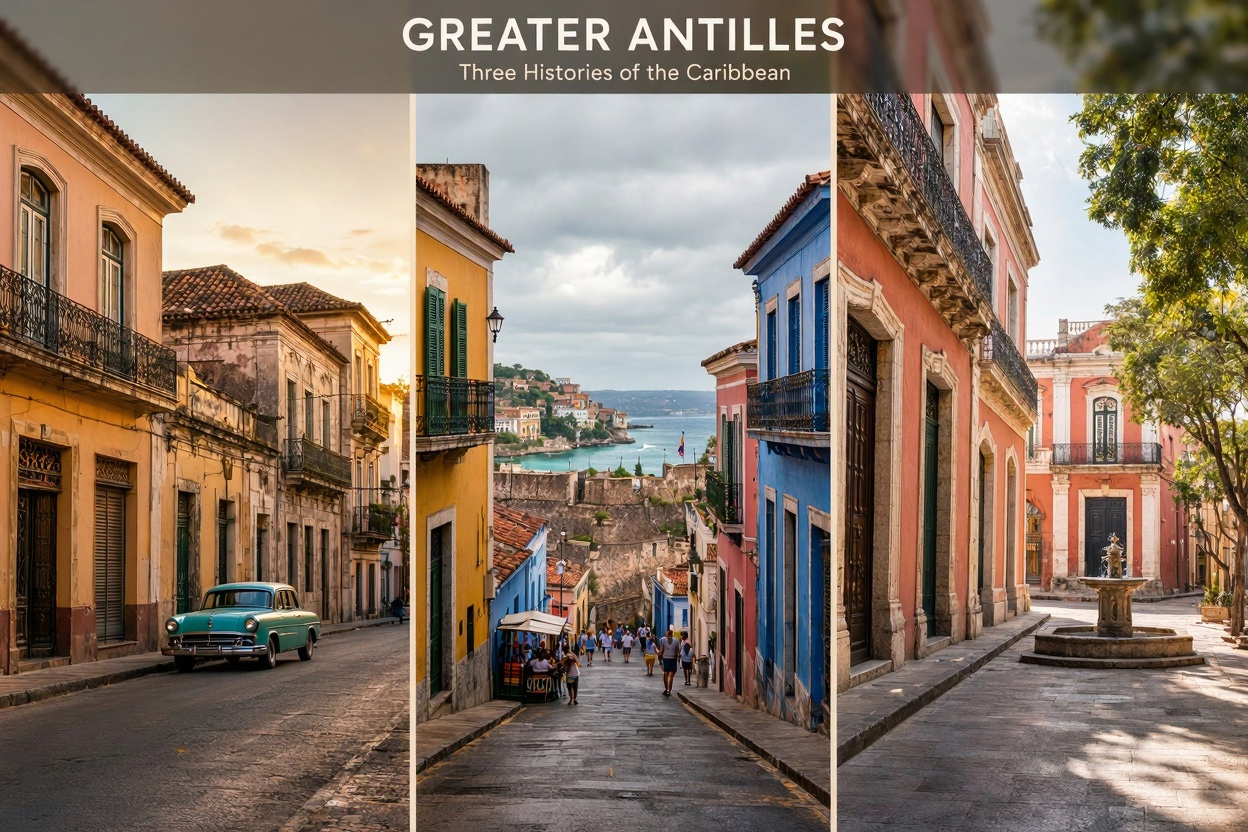
Greater Antilles Travel: Cuba, Puerto Rico & the Dominican Republic
From Colonial Capitals to Modern Identities
In Week 1 of the Caribbean Arc, we explored the region through its landscapes, food, and light. Reefs, harbors, and volcanic peaks introduced a Caribbean defined by geography and atmosphere. This week, the focus shifts from scenery to history.
The Caribbean is often imagined as a collection of islands surrounded by sea. Yet some of its most compelling stories are found not along the shoreline, but within its cities.
Havana, San Juan, and Santo Domingo reveal a Caribbean shaped by empire, migration, resistance, and reinvention. Their streets preserve traces of Indigenous worlds, colonial ambitions, African heritage, and modern aspirations. To walk through these cities is to walk through centuries of Atlantic history.
Havana: Empire, Revolution and Memory
Few cities capture the historical imagination quite like Havana.
Founded by the Spanish in the early sixteenth century, the city grew into one of the most important ports in the Americas. Treasure fleets passed through its harbor. Fortresses guarded its approaches. Merchants, sailors, soldiers, and administrators flowed through its streets, linking Cuba to the wider Spanish Empire.
Today, Havana’s colonial core remains one of the most remarkable urban landscapes in the Caribbean. Grand plazas, arcaded buildings, cathedrals, and fortifications stand beside colorful residential streets that continue to serve as the setting for everyday life.
Yet Havana is remembered for more than its colonial past.
The Cuban Revolution transformed the nation’s political and cultural identity during the twentieth century. Its legacy remains visible throughout the city, from public monuments and murals to conversations that connect past struggles with present realities.
To outside observers, Havana is sometimes reduced to nostalgic images of vintage automobiles and faded architecture. Such portrayals miss the complexity of a living city where history is not preserved behind glass but woven into daily experience.
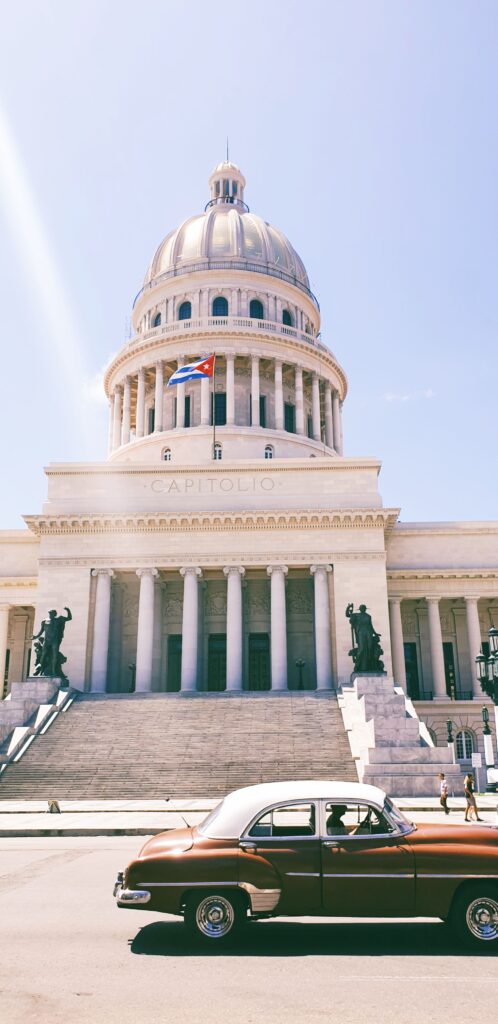
Music drifts from open doorways. Conversations unfold in shaded courtyards. Colonial facades coexist with revolutionary symbolism.
Havana’s greatest attraction may be its ability to hold multiple eras at once.
A City of Layers
Visitors often arrive expecting a city frozen in time.
They leave discovering a city where time remains remarkably visible.
In Havana, the past does not disappear. It accumulates.
Old San Juan: Identity Between Worlds
Across the Caribbean, few places embody layered identity as vividly as Puerto Rico.
Approaching Old San Juan, visitors encounter massive stone fortifications rising above the Atlantic. Built to defend Spanish interests in the Caribbean, these walls protected one of the region’s most strategically important ports for centuries.
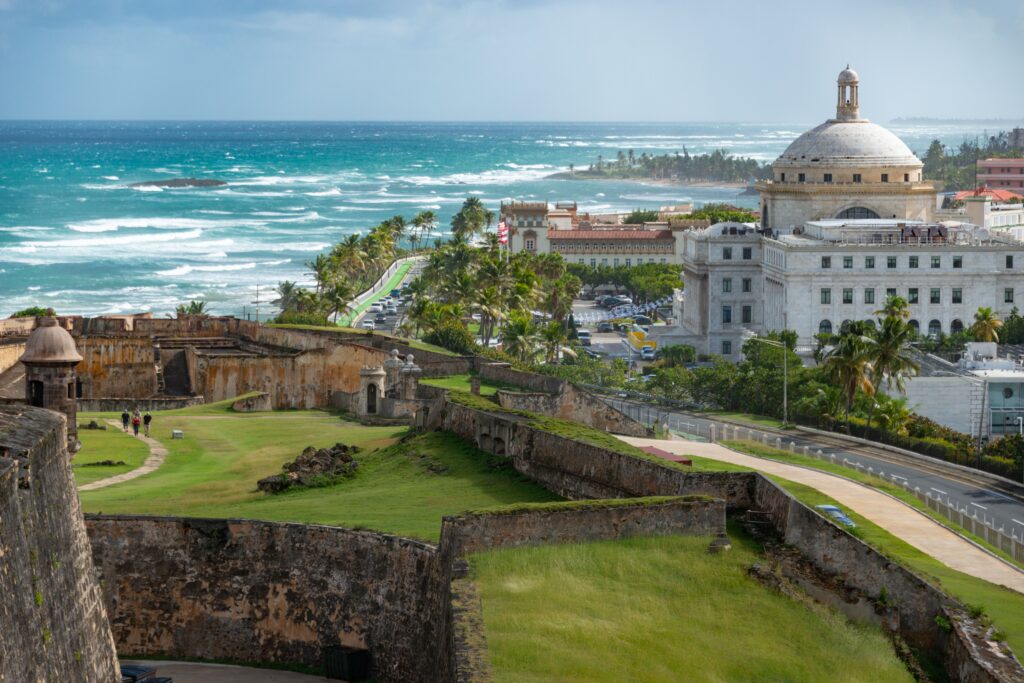
Inside the old city, narrow streets weave between brightly painted buildings, churches, plazas, and government institutions. The urban landscape reflects Puerto Rico’s long relationship with Spain while also revealing influences that emerged after the island came under American administration.
The result is a cultural space that often defies simple definition.
Puerto Rico belongs fully to the Caribbean, yet its relationship with the United States creates political and social realities unlike those of many neighboring islands. Spanish remains the dominant language of everyday life, while economic, political, and cultural links connect the island to North America.
For generations, migration between Puerto Rico and the mainland United States has created a global Puerto Rican community whose sense of identity extends beyond geography.
Identity in Motion
Perhaps more than any other island in the Caribbean, Puerto Rico demonstrates that identity is not static.
It evolves through movement, encounter, and adaptation.
The island’s culture reflects Indigenous roots, Spanish colonial history, African heritage, and modern global influences. Rather than replacing one another, these layers coexist. You can taste those layers in its street food, from bacalaítos to alcapurrias, as explored in What is your favourite street food? Part 4.
Old San Juan therefore offers more than architectural beauty.
It provides a window into the ways cultures endure while continuing to change.
Santo Domingo: Where the Colonial Story Begins
If Havana tells the story of empire and revolution, and San Juan explores identity between worlds, Santo Domingo directs attention to origins.
Founded in the late fifteenth century, Santo Domingo is the oldest continuously inhabited European city in the Americas. Its historic center preserves some of the earliest examples of colonial architecture in the Western Hemisphere.
Walking through the Colonial Zone, visitors encounter churches, government buildings, plazas, and residences that emerged during the earliest phase of European expansion into the New World.
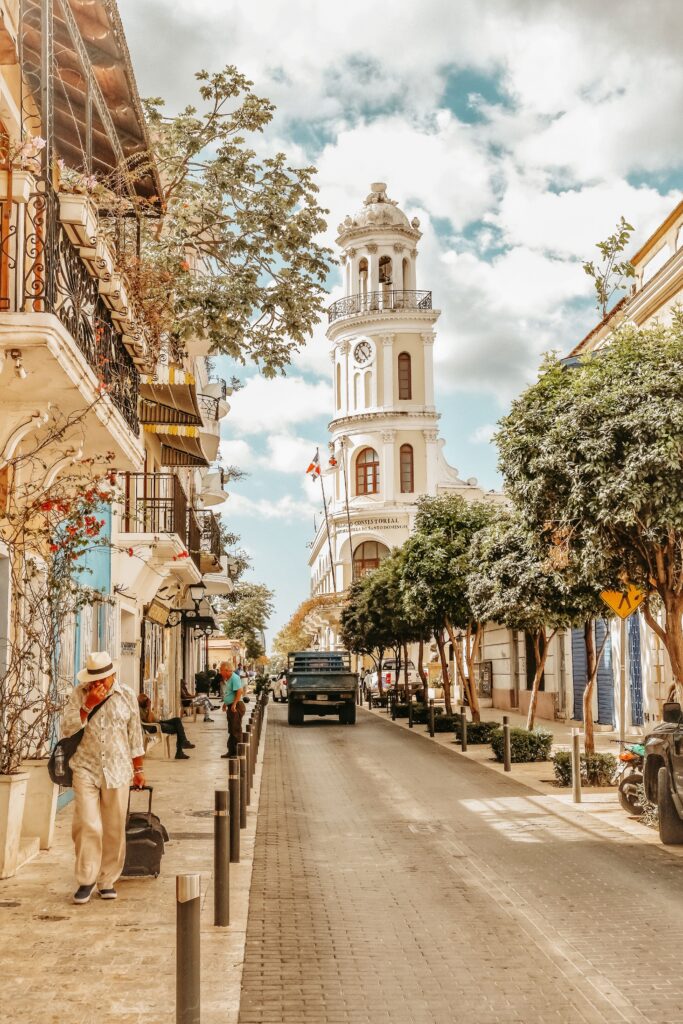
Yet Santo Domingo is not merely a colonial museum.
Like Havana and San Juan, it remains a living city shaped by many influences.
The Dominican Republic’s cultural identity reflects centuries of interaction between Indigenous communities, European colonists, enslaved Africans, and later migrations. Music, dance, cuisine, and language reveal the blending of traditions that characterizes much of the Caribbean.
The city also serves as an introduction to a nation whose influence extends far beyond its borders. Dominican communities throughout the Americas continue to maintain cultural ties to the island, creating networks that link local traditions with global experiences.
Greater Antilles Travel and Dominican Culture
In Santo Domingo, history often feels close at hand.
A colonial building may stand beside a modern café. A centuries-old plaza may host contemporary gatherings. The result is not a conflict between past and present but a conversation between them.
Few cities illustrate the continuity of Caribbean history as clearly.
Greater Antilles Travel Through Three Histories
At first glance, Cuba, Puerto Rico, and the Dominican Republic appear to share much in common.
All were shaped by Spanish colonization.
All became centers of Atlantic trade.
All absorbed influences from Europe, Africa, and the Americas.
Yet each followed a distinct historical path.
Cuba developed a powerful narrative centered on revolution and national sovereignty.
Puerto Rico navigated the complexities of a Caribbean identity linked to the United States.
The Dominican Republic preserved some of the earliest chapters of colonial history while developing a cultural identity uniquely its own.
Their differences remind us that the Caribbean is not a single story.
It is a collection of interconnected stories.
Beyond the Beaches
Travel marketing often highlights tropical coastlines, turquoise waters, and year-round sunshine.
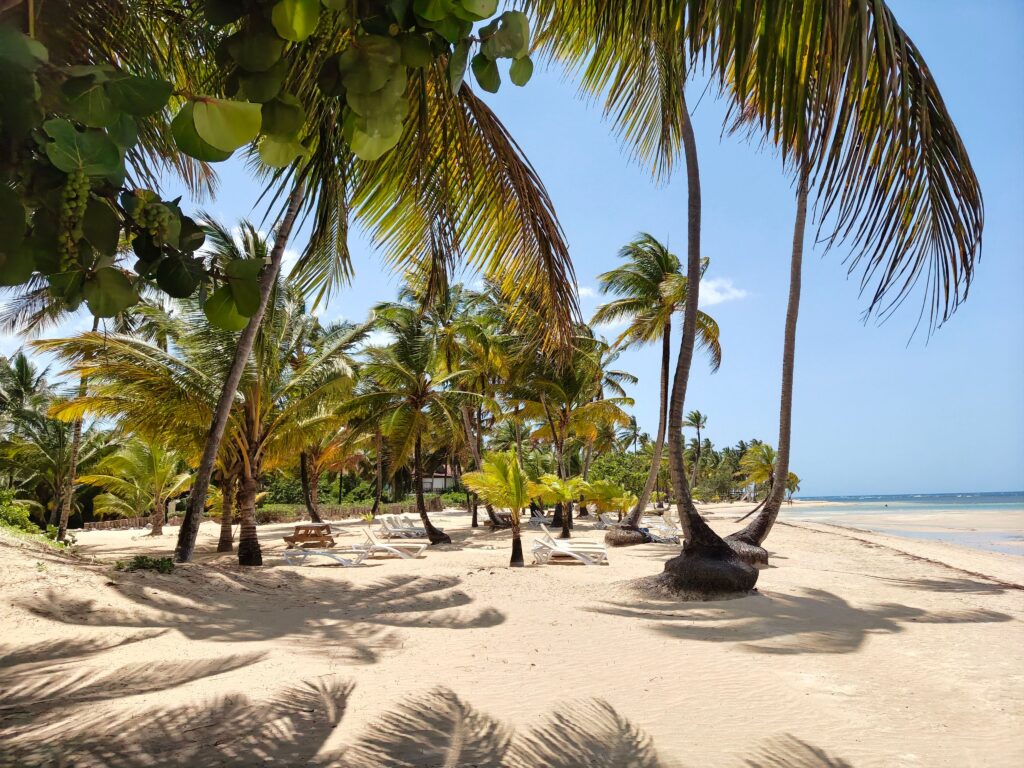
Those landscapes are undoubtedly part of the Caribbean experience.
Yet Havana, San Juan, and Santo Domingo reveal something deeper.
They demonstrate that the Caribbean is also a historical crossroads where continents, cultures, and peoples have met for centuries.
The region’s cities tell stories of exploration and empire, migration and resistance, adaptation and renewal. Their architecture preserves memory. Their streets reflect continuity and change. Their communities embody histories that remain unfinished.
If Week 1 introduced the Caribbean through the colors of its landscapes, Week 2 begins by exploring the people and events that shaped those landscapes into places of meaning.
The Greater Antilles remind us that the Caribbean is not merely a destination.
It is one of the world’s great cultural crossroads, where history remains visible not only in monuments and museums, but in everyday life itself.
From Week 1 of the Caribbean Arc:
- Belize Antigua St Lucia Travel: Three Shades of Blue
- Caribbean Food Staples: Plantains, Coconut, Saltfish & Fruit
- Caribbean Tropical Light: From Desert Gold to Turquoise
Coming next:
- Coffee, Cocoa & Sugar: The Crops That Shaped the Caribbean
- A Micro‑Essay on Islands and Identity