
Caribbean Horizons and Home: A Micro-Essay
A Micro‑Essay on Horizons and Home
This essay continues the journey begun in Caribbean Sea Routes: Migration, Trade & Connection and Caribbean Seafood: Markets & Coastal Traditions. Over the past month, the Caribbean Arc has explored landscapes, food, light, history, trade, identity, music, memory, and the sea itself. Now, it arrives at a question that quietly underlies them all:
What is home?
For island societies, home is often inseparable from the horizon.
The horizon is one of the first things an island teaches its inhabitants to notice. It is always present. It frames the edge of vision. It marks the meeting point between sea and sky while suggesting places that lie beyond both.
To stand on an island is to live with the awareness that elsewhere exists.
And yet, paradoxically, islands often cultivate some of the strongest senses of belonging in the world.
Caribbean Horizons and the Promise of Elsewhere
A horizon represents possibility.
It invites curiosity. It encourages movement. Every ship that appears in the distance carries the promise of arrival. Every vessel departing towards the horizon suggests a future not yet known.
Throughout Caribbean history, horizons have carried explorers, merchants, migrants, labourers, travellers, and dreamers.
Some departed seeking opportunity.
Others arrived seeking refuge.
Many experienced both journeys.
Caribbean Horizons Beyond the Shore
Islands teach people to look outward.
The sea encourages awareness of connection, movement, and distance. Horizons become reminders that life extends beyond familiar shores.
Yet they also remind us of what remains behind.
Every departure implies a place worth remembering.
The Meaning of Home
Home is often described as a location.
A house.
A street.
A neighbourhood.
An island.
But memory complicates geography.
People leave home for many reasons. Some return. Others never do. Yet even when distances grow, the idea of home often persists.
Sometimes it survives through food.
Sometimes through music.
Sometimes through stories shared across generations.
Home becomes less about coordinates and more about continuity.
Carrying Home
The Caribbean diaspora offers countless examples of this experience.
Communities spread across continents often maintain connections to islands they may visit only occasionally. Traditions, recipes, languages, and songs become ways of carrying home into new environments.
The physical landscape may remain far away.
Its influence remains close.
Sea, Distance, and Belonging
The sea occupies a unique position in the Caribbean imagination.
It creates separation.
It enables connection.
It introduces distance while making movement possible.
The same waters that carried people away also carried ideas, traditions, and memories back again.
The Sea Between Homes
For many Caribbean families, belonging cannot be reduced to a single place.
Life unfolds across multiple locations connected by travel, family ties, and shared history.
In such circumstances, home becomes something larger than geography.
It becomes a relationship.
Returning to the Horizon
Every journey eventually brings us back to the horizon.
Not because we have reached an ending, but because horizons never remain fixed. Each one reveals another beyond it.
The Caribbean reminds us that identity, memory, and belonging work in much the same way.
They evolve.
They expand.
They absorb new experiences while preserving older connections.
What appears distant can remain deeply familiar.
What appears temporary can become lasting.
Home Beyond Arrival
Perhaps home is not simply where a journey begins or ends.
Perhaps it exists within the connections formed along the way.
The people we remember.
The traditions we inherit.
The stories we carry.
The horizons we continue to follow.
What Remains
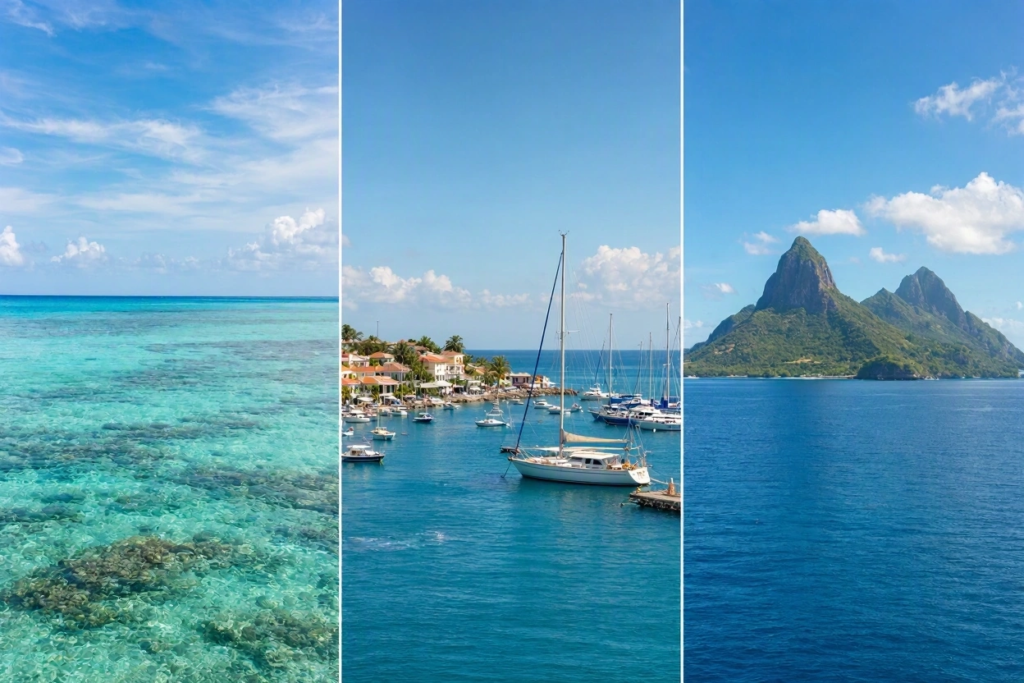
At the beginning of this Caribbean Arc, we encountered turquoise waters, reefs, harbours, and mountains. We explored foods shaped by climate and history, cities shaped by empire and identity, music shaped by memory, and sea routes shaped by movement.
Yet beneath every theme ran a common thread.
Connection.
The Caribbean demonstrates that islands are not isolated worlds standing apart from history. They are meeting places where cultures, memories, and people continually intersect. The sea separates their shores, yet binds their stories together. The horizon appears to divide sea from sky, yet joins them in a single line.
And perhaps that is the Caribbean’s enduring lesson.
Home is not always a place we leave behind.
Sometimes it is something we carry with us, across every sea we cross and beyond every horizon we follow.
The Caribbean Arc
Week 1: Place, Food and Light
- Belize Antigua St Lucia Travel: Three Shades of Blue
- Caribbean Food Staples: Plantains, Coconut, Saltfish & Fruit
- Caribbean Tropical Light: From Desert Gold to Turquoise
Week 2: History, Trade and Identity
- Greater Antilles Travel: Cuba, Puerto Rico & the Dominican Republic
- Coffee, Cocoa & Sugar: The Crops That Shaped the Caribbean
- Caribbean Identity: Islands, Memory and Belonging
Week 3: Music, Flavour and Memory
- Rhythms of the Caribbean: Cuba, Jamaica & Trinidad
- Rum, Spice & Citrus: Caribbean Flavours Across the Islands
- Caribbean Rhythm and Memory: A Micro-Essay
Week 4: Sea, Shore and Home